
E-commerce in Europe 2027: market, buyers and EU rules
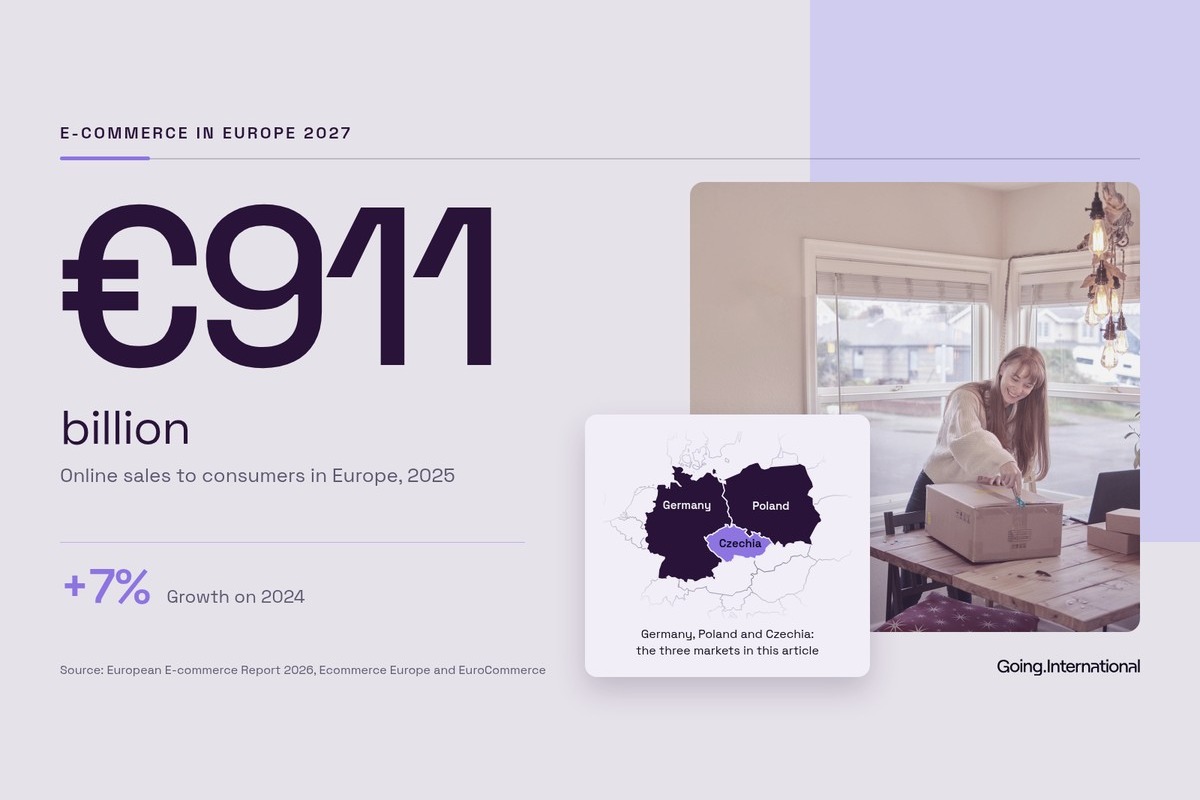
E-commerce in Europe grew 7% to €911 billion in 2025, but the growth is uneven and the rules are getting stricter. This update shows what that means for a brand planning its 2027 market entry.
E-commerce in Europe grew 7% to €911 billion in 2025, but the growth is uneven and the rules are getting stricter. This update shows what that means for a brand planning its 2027 market entry.
E-commerce in Europe grew 7% to €911 billion in 2025, but the growth is uneven and the rules are getting stricter. This update shows what that means for a brand planning its 2027 market entry.
The figure comes from the European E-commerce Report 2026, which the industry associations Ecommerce Europe and EuroCommerce published in September and which covers online sales to consumers in 38 countries. Most European e-commerce growth now comes from a few regions and channels. We use Germany, Poland and Czechia as worked examples, because together they show three very different entry plans.
Key takeaways
- Western Europe is the largest market, Eastern Europe grows fastest on paper. Eastern Europe grew 14% in 2025, but only 5% after inflation. Choose your next market by the margin it leaves after delivery, returns and compliance.
- Marketplaces set the standard for price and delivery. Decide before launch whether you enter through a marketplace, your own shop or both, and price each channel separately.
- The EU's duty-free limit for small parcels has gone. Parcels from Temu, Shein and other sellers outside the EU now pay duty. That narrows the price gap without closing it, so compete on trust, service and local presence.
- Buyers ask AI assistants, in their own language. Budget for visibility in AI answers next to SEO, in every market.
- Compliance is a launch cost. Packaging, product safety, accessibility, green claims and a withdrawal button all apply by the end of 2026. Plan them before the first campaign.
How big is e-commerce in Europe?
The European E-commerce Report 2026, published on 22 September 2026, puts business-to-consumer e-commerce in Europe at €911 billion for 2025: 7% more than in 2024, or 4% after inflation. The EU-27 accounted for €715.8 billion. For 2026 the report forecasts 5% growth, to €961 billion.
The growth is uneven. Western Europe, the largest region with 57% of turnover, grew slowest at 5%. Southern Europe grew 11% and Eastern Europe 14%, but in Eastern Europe inflation of 8.4% took most of that: real growth was 5%, and the report expects inflation-adjusted turnover there to fall by 1% in 2026.
Buyers differ as much as markets do. Three in four Europeans aged 16 to 74 bought something online in 2025: 85% in Northern Europe, against 60% in Eastern Europe. A lower share leaves room to grow, but it also means buyers who take longer to trust a shop they do not know.
Which country is best for e-commerce? That depends on your category. The best market is the one that still leaves a margin after delivery, returns, payment fees, duties and compliance.
Germany, Poland and Czechia: three markets, three entry plans
Germany
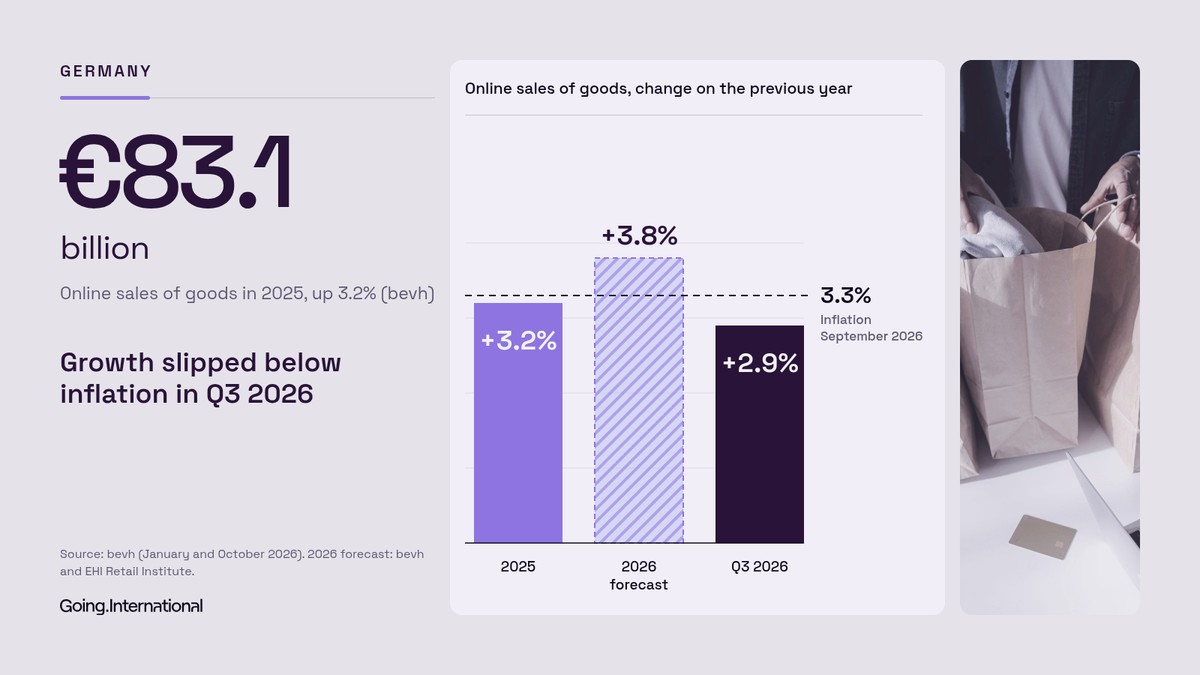
Germany is the largest of the three and grows the slowest. Online sales of goods grew 3.2% in 2025 to €83.1 billion, according to the German e-commerce association bevh, and 56% of that ran through marketplaces. For 2026, bevh and the EHI Retail Institute forecast nominal growth of 3.8%, and the German Retail Federation (HDE) 4.3%. The year is uneven so far: sales grew 4.3% in the first half of 2026, but only 2.9% in the third quarter, below September's inflation rate of 3.3%, as energy prices rose and consumer sentiment weakened. Marketplaces grew 5% in that quarter, while pure online shops lost 0.8%. A new brand in Germany mostly wins share from competitors rather than from market growth, and the marketplace is the default shop window.
Our 2025 article on e-commerce in Germany gives the background on German buyers and what they expect. The points below bring it up to date with 2026 figures and rules:
- Buyers. 81% of people in Germany aged 16 to 74 bought online in 2025, according to Eurostat. Online shoppers are getting older: their number grew 1.2% in 2025 overall and 3.1% among people over 55, according to HDE's Online-Monitor 2026.
- Payment. In 2025, PayPal took 28.7% and purchase on invoice (Kauf auf Rechnung) 26.1% of online revenue in the EHI Retail Institute's payment panel of 172 retailers. A checkout without both asks German buyers to change a habit. Wero, the European banks' account-to-account payment method, has been live for online purchases in Germany since the end of 2025, and payment providers began connecting German online shops to it in 2026.
- Returns. In our 2025 study of Germany's top 100 online shops, 84% offered free returns. The trend has moved further that way: in an EHI survey of 108 online retailers in the DACH region in summer 2026, 60.6% paid the full cost of returns, up from 49.2% a year earlier, and in fashion 67.5% of retailers had a return rate above 20%. Build the expected return rate into each market's business case from day one.
- AI assistants. In a bevh survey of 2,500 online shoppers in the second quarter of 2026, 31.2% had already asked a chatbot for product recommendations, but only 12.7% would follow such a recommendation without searching further. According to HDE, 35% of people in Germany use AI to research products before they buy.
- Trust. German law requires an Impressum, a page with the company's name, address, email and register details, on commercial websites (section 5 of the Digitale-Dienste-Gesetz). In our experience, German buyers look for it, for reviews from other German buyers and for a German returns address before they order from a shop they do not know.
- Registrations. Since 12 August 2026, the EU packaging regulation and the German Packaging Law Implementation Act (VerpackDG) have replaced the Packaging Act, and registration in the LUCID packaging register remains mandatory. Electrical goods and batteries are registered with Stiftung EAR; since 18 August 2025, battery producers without a German establishment have to register through an authorised representative.
Poland
Poland is growing fastest. Statistics Poland reported that retail sales via the internet were 18.7% higher in September 2026 than a year earlier, in current prices, and that the internet's share of retail sales rose from 9.0% to 10.1%. These figures cover companies with more than nine employees. Marketplaces matter here as well: 64% of Polish companies with ten or more employees that sell online also sell through marketplaces, the third highest share in the EU after Lithuania and Italy. A market growing this fast is cheaper to enter before your category fills up, but it expects a Polish shop, Polish payment options and Polish customer service from day one.
Czechia
Czechia is smaller and mature, with strong local players. Czech online sales grew by more than 6% in 2025 to CZK 206 billion, according to the Czech e-commerce association APEK and Heureka. APEK has also warned that Asian platforms often disregard European safety and environmental rules, which puts pressure on local shops. In our experience, Czech buyers compare prices and delivery times closely, so a foreign brand needs a clear reason to be chosen over a local shop that delivers the next day.
Asian platforms and the end of the EU de minimis exemption
Until the end of June 2026, the EU's de minimis exemption let a parcel worth less than €150 reach an EU buyer from outside the EU without customs duty. According to the European Commission, around 4.6 billion such low-value consignments entered the EU in 2024, about 12 million a day. Since 1 July 2026, a flat duty of €3 applies to each item category in such a parcel, as a temporary measure until the EU Customs Data Hub starts in 2028. Since 1 November 2026, a handling fee of €2 per item applies on top, whatever the parcel's value.
Germany shows how quickly this moves a market. In 2025, Shein, Temu and AliExpress accounted for 30% of the growth in German online sales of goods, €791 million of €2.6 billion, according to bevh. In the third quarter of 2026, the first full quarter with the duty, their German sales fell 35.5% to €566 million, and their share of German online sales dropped from 5.3% to 3.1%. Our analysis of Temu's rise in Germany shows how the platform grew there and how regulators responded.
Oversight has tightened as well. On 28 May 2026, the European Commission fined Temu €200 million under the Digital Services Act for failing to assess the risks of illegal products being offered on its platform.
For a European brand, this is good news with a limit. A few euros of duty will not turn a buyer who shops on price into one who shops on brand. The stronger position is the one these platforms find hardest to copy: local delivery and returns, service in the buyer's language, product information that meets EU rules, and a name that buyers, reviewers and AI assistants in that market already know.
Buyers now ask AI assistants too
On 7 October 2025, Google launched AI Mode, its conversational search, in more than 35 new languages, and German, Czech and Polish are among the languages it supports. According to Eurostat, 32.7% of people aged 16 to 74 in the EU used a generative AI tool in 2025, and 63.8% of those aged 16 to 24.
For a brand entering a new market, this moves the first impression. Asked which brands to consider, an assistant names only a handful. It draws on what the web already says about each brand in that language: reviews, press, comparison pages, forums and the brand's own site. A brand new to a market has little of that yet, so it can rank for its own name and still be missing from the answer.
What to do before launch:
- Write down the ten to twenty questions a buyer in the new market would ask, in their language, from "which brands make good X" to "is brand Y reliable".
- Ask them in ChatGPT, Gemini, Google AI Mode and Perplexity, and note which brands are named and which sources are cited.
- Repeat the same questions every month and report the result next to your rankings, per market.
The sources that keep coming up tell you where your PR, reviews and local content should go first. On 18 November we publish the full method we use: 30 buying prompts, four AI engines and a scoring sheet.
EU e-commerce rules that apply in 2027
Most of these rules apply to any shop that sells to EU consumers, wherever it is based.
| Rule | Applies from | What it means for a shop |
|---|---|---|
| General Product Safety Regulation | 13 December 2024 | A responsible operator in the EU for every product; listings show the manufacturer, product identification and safety information |
| European Accessibility Act | 28 June 2025 | Shops selling to consumers must be accessible; micro-enterprises providing services are exempt |
| Withdrawal button (Directive (EU) 2023/2673) | 19 June 2026 | A clearly labelled online function to withdraw from the contract |
| Customs duty on low-value parcels | 1 July 2026 | €3 per item category on parcels under €150 from outside the EU, until 2028 |
| Packaging and Packaging Waste Regulation | 12 August 2026 | One EU packaging regulation; producers register in each country they ship to |
| Empowering Consumers for the Green Transition Directive | 27 September 2026 | No unproven generic claims such as "eco-friendly", no "climate neutral" claims based on offsetting |
| Customs handling fee | 1 November 2026 | €2 per item on distance sales from outside the EU, whatever the value |
| Product Liability Directive (EU) 2024/2853 | 9 December 2026 | Covers software too; for goods made outside the EU, the importer or authorised representative can be liable |
Each country adds its own registrations on top, as the German example above shows.
What this means for your 2027 budget
Five decisions belong in the 2027 plan for any new European market.
- Choose the market by the margin it leaves. Model delivery, returns, payment fees, duties and compliance per market before you compare revenue potential. Is e-commerce still profitable? For brands that do this work up front, yes; in some categories, Germany's free-returns standard alone decides the business case.
- Decide the channel mix before launch. Marketplace, own shop or both: each needs its own pricing, stock and content plan. In Germany more than half of online sales run through marketplaces, and in Poland nearly two in three companies that sell online use them.
- Localise trust as well as text. Native copy, local payment methods, a local returns address, the legal pages each market expects and reviews from buyers in that country.
- Report two visibility numbers per market. Rankings show how Google sees you. Whether AI assistants name you when buyers ask for a recommendation is a second number, and the two can differ sharply. Report both, per market and in that market's language.
- Make compliance a budget line with an owner. Registrations, product safety information, accessibility, the withdrawal button and green claims each take weeks. Plan them before launch rather than after the first blocked listing.
Which of these five decisions is the hardest one to get through your board?
Our e-book on AI-assisted market analysis shows how we compare markets before an entry decision, and our international expansion team works through these decisions with brands before launch.
Sources
- Ecommerce Europe and EuroCommerce, "European e-commerce reaches €911 billion as sector calls for fairer competition", press release, 22 September 2026 (€911 billion in 2025, plus 7%, 4% real; 38 countries; 2026 forecast plus 5% to €961 billion; Western Europe 57% of turnover and plus 5%, Northern plus 6%, Central plus 8%, Southern plus 11%, Eastern plus 14%; 74% of Europeans aged 16 to 74 bought online in 2025, Northern 85%, Western 84%, Southern 63%, Eastern 60%).
- Ecommerce Europe and EuroCommerce, "European E-commerce Report 2026, Executive Summary", 22 September 2026 (EU-27 €715.8 billion; Eastern Europe inflation 8.4%, real growth 5%, 2026 forecast of a 1% real decline; web sales via marketplaces among EU-27 enterprises with ten or more employees and web sales: Lithuania 87%, Italy 65%, Poland 64%).
- bevh, "Aufbruch oder verlorenes Jahrzehnt?", annual press conference presentation, January 2026 (online goods revenue €83.1 billion in 2025 including VAT, plus 3.2%; marketplaces 56%, €46.2 billion; Temu, Shein and AliExpress €791 million of €2,577 million total growth, "30 % des Marktwachstums").
- bevh, "Erste Halbzeit im Onlinehandel: Kaufneigung der Deutschen kehrt zurück", press release, 6 July 2026 (Q2 2026 growth 5.1%).
- bevh, "Nach Abschaffung der Zollfreigrenze: Asiatische Plattformen verlieren deutlich Marktanteile", press release, 8 October 2026 (Q3 2026 online goods revenue about €18.5 billion, plus 2.9%; Shein, Temu and AliExpress €566 million, minus 35.5% year on year; share 5.3% in Q2 to 3.1% in Q3; duty "3 Euro pro Warengruppe" since July, "Bearbeitungsgebühr von 2 Euro" from November).
- bevh, "Wachstum im E-Commerce: Lichtblick in der deutschen Wirtschaft", annual press conference release, 22 January 2026 (83.1 billion euros in 2025 after 80.6 billion, plus 3.2%; marketplaces 56%; joint bevh and EHI forecast for 2026: "ein (nominales) Umsatzwachstum im E-Commerce mit Waren von 3,8 Prozent").
- EHI Retail Institute, "Smartphone statt Portemonnaie: Mobile Payment boomt", press release, 5 May 2026 (study "Zahlungssysteme im Einzelhandel 2026": "An erster Stelle behauptet Paypal mit 28,7 Prozent (2024: 28,5 Prozent) seine Spitzenposition im E-Commerce. Der Kauf auf Rechnung folgt dahinter mit 26,1 Prozent (2024: 25,8 Prozent)"; revenue shares; online payment panel of 172 companies with €50.7 billion net online revenue).
- EHI Retail Institute, "Wieder mehr kostenlose Retouren", press release, 30 September 2026 (study "Versand-, Verpackungs- und Retourenmanagement im E-Commerce 2026", 108 online retailers in the DACH region, mostly headquartered in Germany, surveyed in summer 2026: "2026 übernahmen 60,6 Prozent der Händler die Rücksendekosten vollständig gegenüber 49,2 Prozent im Vorjahr"; fashion: "2026 lagen 67,5 Prozent der Händler in diesem Sortiment bei einer Retourenquote von mehr als 20 Prozent").
- HDE, "Online-Handel als Wachstumstreiber für den Einzelhandel: Marktplätze von großer Bedeutung, Nutzer werden älter", press release on the HDE Online-Monitor 2026, 3 June 2026 (2026 forecast "um nominal 4,3 Prozent"; marketplaces 56.7% of online revenue in 2025; online shoppers plus 1.2% overall and plus 3.1% among over-55s in 2025; "Schon heute nutzen 35 Prozent der Menschen in Deutschland KI zur Recherche beim Kauf von Produkten").
- Eurostat, "Internet purchases by individuals (2020 onwards)", dataset isoc_ec_ib20 (tin00096), last online purchase in the last 12 months, all individuals aged 16 to 74, Germany 2025: 81.38%.
- Nexi, "Nexi implementiert Wero im deutschen E-Commerce", press release, 28 April 2026 ("Im Bereich der Massenzahlungen ist Wero seit Ende 2025 in Deutschland live"; BAUR, Quelle and Bünting among the first online shops being connected).
- Digitale-Dienste-Gesetz (DDG), § 5 "Allgemeine Informationspflichten" (name and address, contact details including email, register entry and number, VAT ID for "geschäftsmäßige, in der Regel gegen Entgelt angebotene digitale Dienste").
- Zentrale Stelle Verpackungsregister (ZSVR), "PPWR and German Packaging Law Implementation Act (VerpackDG): what is changing for you" ("On 12 August 2026, the EU Packaging and Packaging Waste Regulation (PPWR), together with the German Packaging Law Implementation Act (VerpackDG), replaced the existing German Verpackungsgesetz"; "registration, system participation and data reporting will remain in place").
- stiftung ear, "Neue Batterieverordnung tritt in Kraft: stiftung ear bereit für den Vollzug", press release, 18 August 2025 (stiftung ear "bleibt für die Registrierung von Herstellern zuständig"; "Hersteller ohne Niederlassung in Deutschland müssen sich künftig durch einen Bevollmächtigten registrieren lassen").
- Statistics Poland (GUS), "Sprzedaż detaliczna we wrześniu 2026 r.", Informacje sygnalne, 22 October 2026 (PDF release: internet sales plus 18.7% year on year in current prices; share of internet sales 9.0% to 10.1%; enterprises with more than nine employees).
- MediaGuru, "Obrat e-commerce dosáhl loni 206 miliard korun", 15 January 2026 (APEK and Heureka: CZK 206 billion in 2025, growth "o více než 6 %"; APEK: Asian platforms "často nerespektují evropská pravidla pro bezpečnost či ekologii").
- European Commission, "Commission announces actions for safe and sustainable e-commerce imports", IP/25/410, 5 February 2025 (around 4.6 billion low-value consignments in 2024, 12 million parcels per day).
- European Commission, "EU introduces customs duties on low-value e-commerce packages", IP/25/3045, 12 December 2025 ("€3 customs duty per item" on parcels below €150 from July 2026, temporary until the EU Customs Data Hub in 2028; handling fee separate).
- Council of the EU, "Customs: Council agrees to levy customs duty on small parcels as of 1 July 2026", 12 December 2025 (duty applied to each item according to its tariff heading).
- Irish Revenue Commissioners, "Union Handling Fee (UHF), 1 November 2026" ("€2 per distinct item" from 1 November 2026, "regardless of the value of the purchase. There is no threshold").
- European Commission, "Commission fines Temu €200 million for breaching the Digital Services Act", IP/26/1178, 28 May 2026 (Temu "failed to diligently identify, analyse, and assess the systemic risks of illegal products being offered on its platform").
- Google, "AI Mode is now available in more languages and locations around the world", 7 October 2025 ("more than 35 new languages"; the post does not list them).
- Google Search Help, "Get AI-powered responses with AI Mode in Google Search" (German, Czech and Polish in the list of supported languages, checked 28 October 2026).
- Eurostat, "32.7% of EU people used generative AI tools in 2025", 16 December 2025.
- Eurostat, "64% of 16-24-year-olds used AI in 2025", 10 February 2026 (63.8% of people aged 16 to 24 used generative AI tools).
- going.international, "Free Returns: What Germany's Top 100 Online Shops Reveal About Customer Expectations", 4 September 2025 (84% of shops offer free returns).
- going.international, "E-commerce in Germany: Key Trends and Challenges in 2025", 23 February 2025.
- Regulation (EU) 2023/988 on general product safety (applies from 13 December 2024; Articles 4 and 19).
- Directive (EU) 2019/882, the European Accessibility Act (applies from 28 June 2025; micro-enterprises providing services exempt).
- Directive (EU) 2023/2673 (withdrawal function for distance contracts concluded online, new Article 11a of the Consumer Rights Directive, applies from 19 June 2026).
- Regulation (EU) 2025/40 on packaging and packaging waste (applies from 12 August 2026; register of producers per Member State).
- Directive (EU) 2024/825, empowering consumers for the green transition (applies from 27 September 2026).
- Directive (EU) 2024/2853 on liability for defective products (applies to products placed on the market after 9 December 2026).
Table of contents
How we can help you
Our team will help you with the first steps of your expansion as well as long-term marketing strategies.